About this course
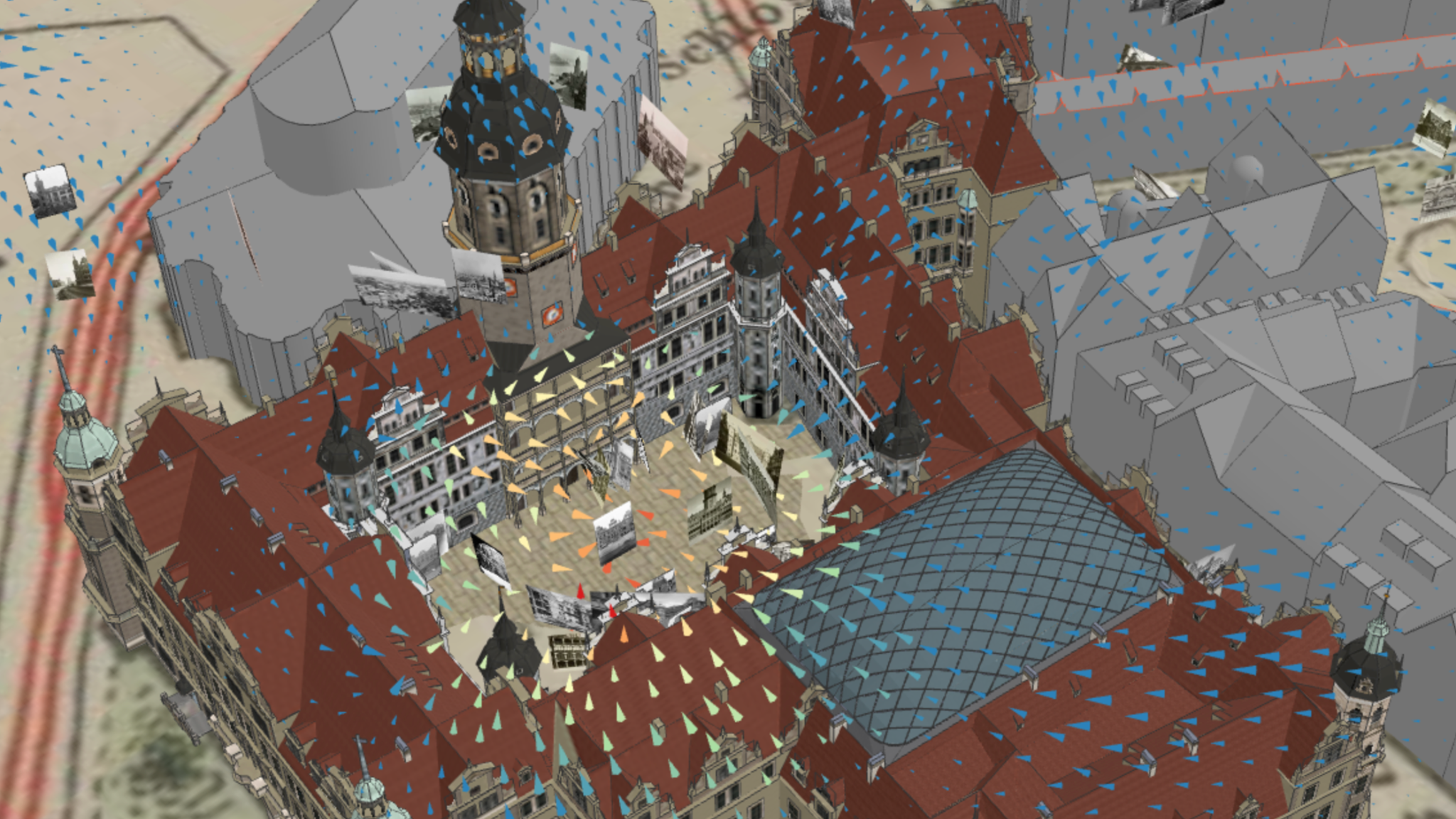
In the previous course, Introduction to the 4D Browser, you became familiar with the 4D Browser. You learned how to navigate the 3D model of Dresden, explore historical photographs, and use time to investigate how the city has changed.
This course builds on those foundations and focuses on advanced exploration and interpretation. You will work with the 4D Browser to investigate historical change in greater depth, use visualisation tools to identify and interpret patterns, and explore textual information connected to buildings, photographs, and locations.
By combining these different sources and data layers, you will practise using the 4D Browser not only to explore Dresden's past, but also to develop and support your own historical interpretations.
Who is this course for?
This course is designed for learners who have completed Introduction to the 4D Browser or who already have basic familiarity with the 4D Browser interface.
You should be comfortable with basic navigation and know how to explore the 3D city model, historical photographs, and the time dimension.
What will you learn?
By the end of this course, you will be able to:
- analyse historical changes in Dresden using the 4D Browser's time-based features;
- use and interpret visualisation tools to identify patterns and relationships in the data;
- interpret textual information linked to buildings, photographs, and locations in their historical context;
- combine different data layers and sources to develop evidence-based interpretations of urban change.
Technical requirements
The 4D Browser is a prototype application and is not yet fully optimised for all browsers or interaction methods.
For the best learning experience, we recommend:
- using an up-to-date browser with HTML5/WebGL support; Google Chrome generally provides the best performance;
- using a computer or laptop with a Full HD screen resolution (1920 × 1080 pixels); the course is not designed for mobile devices;
- using a mouse rather than a touchpad, as touchpad interaction is not yet fully optimised.
Course staff
Richard Joos
Richard Joos is a research associate (Master of Arts). He studied Art History (Bachelor's & Master's) in Dresden. His research interests include digital art, internet and meme culture, virtual reality and 3D virtualization, gamification, and game studies.
Sander Münster
Sander Münster is a professor of Digital Humanities at the Friedrich Schiller University in Jena. His research interests include 3D and 4D modelling and visualization of cultural heritage, information behaviour, digital heritage education, and communities.